1. Why Finished Basements Are Higher Risk
Radon enters your home from the soil beneath it, and your basement is the closest living space to that source. The concrete slab floor sits directly on the soil, and any cracks, joints, or penetrations in that slab are pathways for radon gas to travel into your living space.
An unfinished basement may have some natural ventilation. Open windows, gaps around the sill plate, and an uninsulated building envelope allow some air exchange with the outdoors. This air exchange dilutes indoor radon to some degree.
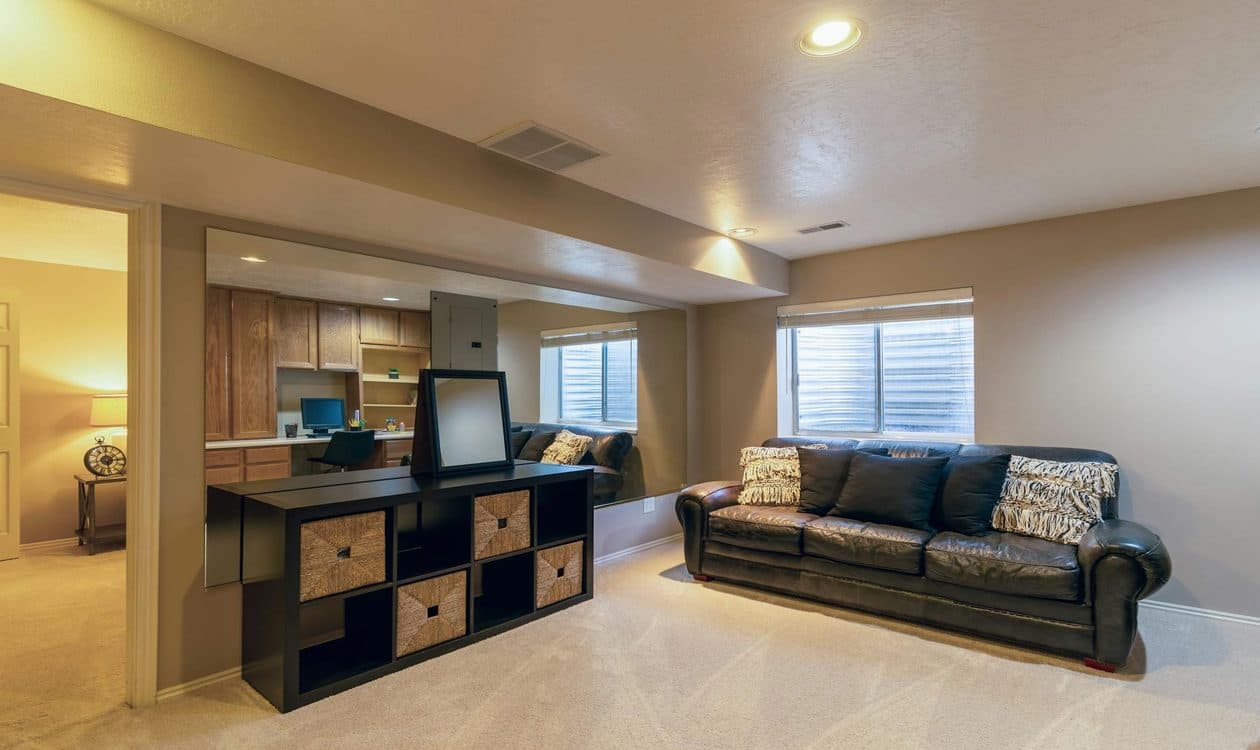
A finished basement, by contrast, is designed to be comfortable. That means insulated walls, sealed gaps, weather-stripped windows, and often its own HVAC zone. All of these improvements make the space more livable, but they also make it more effective at trapping radon.
The bigger concern is exposure time. An unfinished basement might get occasional use for laundry or storage. A finished basement is a family room, a home office, a playroom, or a guest bedroom. The more hours you and your family spend there, the more your radon exposure matters.
2. How Radon Enters Finished Basements
Even in a beautifully finished basement, radon still enters through the same pathways it always has. Understanding how radon enters your home is key. The finishing materials cover these pathways but do not seal them.
Slab cracks beneath flooring
Carpet, LVP, or tile covers the slab but does not seal it. Radon passes through cracks in the concrete and diffuses through or around the flooring material into the room.
Wall-floor joints behind drywall
The joint where the basement wall meets the floor is a common radon entry point. Framing and drywall cover this joint but do not seal it. Radon enters behind the wall and migrates into the living space through gaps at the top and bottom of the wall assembly.
Utility penetrations
Plumbing pipes, electrical conduits, and HVAC ducts that pass through the slab create gaps around them. These penetrations are often hidden behind finished walls, making them invisible but still active as radon pathways.
Sump pits
If your finished basement has a sump pit, even a covered one, it can be a significant radon entry point. The pit provides a direct opening to the soil below, and unless it is sealed with an airtight cover, radon can enter freely.
3. Testing a Finished Basement
Testing a finished basement for radon follows the same process as testing any other area of your home, but placement matters. The test device should be placed in the main living area of the finished basement, at least 20 inches off the floor, at least 3 feet from exterior walls, and away from windows, doors, and HVAC vents.
A professional radon test uses a continuous monitor that records hour-by-hour readings over a 48-hour period. This gives you a detailed picture of how radon levels fluctuate throughout the day and night. You can see whether levels spike at certain times, which can provide clues about the entry mechanisms.
During the test, maintain closed-house conditions: keep windows and exterior doors closed, run your HVAC as normal, and avoid running whole-house fans. Normal use of the basement is fine. You do not need to avoid the space during testing.
Test the Lowest Livable Level
If you have a finished basement with a bedroom, office, or family room, that is where you test. Even if you spend most of your time on the main floor, the basement test gives you the worst-case reading. If the basement is safe, the upper floors almost certainly are too. If the basement is elevated, you know you need to act.
4. Common Radon Issues in Finished Basements
Several features common in finished basements can contribute to radon problems.
Enclosed Sump Pits
Many finished basements have sump pits that are covered but not sealed airtight. A loose-fitting cover allows radon to escape from the pit into the living space continuously. An airtight, gasketed sump cover is a simple fix that can make a noticeable difference.
Bathroom Plumbing
Basement bathrooms require drain lines cut through the slab. The gaps around these penetrations are common radon entry points. If the space behind the finished wall was not sealed properly during construction, radon can travel through these gaps unseen.
Inadequate Ventilation
Finished basements that rely entirely on the central HVAC system for air circulation may not get enough fresh air exchange. Without adequate ventilation, radon that enters the space accumulates rather than being diluted.
Closed-Off Storage Areas
Unfinished storage rooms or mechanical rooms adjacent to the finished space can be radon reservoirs. Radon accumulates in these sealed-off areas and migrates into the finished space through gaps around doors, ductwork, or framing.
5. Mitigation Options for Finished Basements
If your finished basement tests above 4 pCi/L, a sub-slab depressurization system is the standard solution. This system works by creating negative pressure beneath the slab, drawing radon from the soil before it enters your home and venting it safely above the roofline.
Installing a mitigation system in a finished basement requires coring a small hole (about 5 inches in diameter) through the finished floor and slab. The suction pipe is routed either through a closet, utility room, or along the exterior of the home up to the roof. An experienced professional can complete this installation with minimal disruption to your finished space.
In some cases, the suction point can be placed in an unfinished area adjacent to the finished space, such as a storage room or mechanical room. This avoids any disruption to the finished living area while still providing effective sub-slab depressurization across the entire basement footprint.
Mitigation systems typically reduce radon levels by 90% or more. A post-mitigation test within 30 days of installation confirms the system is working effectively. Most homes see levels drop well below 2 pCi/L after a properly designed system is installed. Regular radon fan maintenance keeps the system running at peak performance. Contact our residential radon services team for a free estimate.
Finished basement owners often find that mitigation addresses a problem they were not initially trying to fix. The same suction that pulls radon from beneath the slab also extracts water vapor from the soil, and EPA research confirmed that homes with active radon systems see statistically significant reductions in basement humidity. This is covered in more detail in our article on the moisture reduction benefits of radon mitigation, which is particularly relevant if your finished basement has ever felt damp or musty.
6. Radon Prevention When Finishing a Basement
If you are planning to finish your basement, this is the perfect time to address radon proactively. Testing before construction and incorporating radon-resistant features into the finishing project can save you significant time and money compared to retrofitting later.
Start by testing the unfinished space. If levels are already elevated, have a mitigation system installed before the finishing work begins. The system components can be integrated into the construction plan, with the suction point placed where it will be hidden by the finished layout.
Even if your pre-finish test is low, consider installing a passive radon pipe during construction. This is a PVC pipe that runs from below the slab through the wall and up to the roof. Without a fan, it provides some passive radon reduction. If levels increase later (after the space is finished and sealed tighter), a fan can be added to activate the system without any demolition or disruption to the finished space.
Smart Planning
The cost of installing a passive radon pipe during a basement finishing project is minimal compared to the overall renovation budget. It provides insurance against future radon issues and can save thousands of dollars if active mitigation is ever needed.