1. Why Pregnant Women Should Care About Radon
During pregnancy, you are naturally more cautious about what you eat, drink, and breathe. You avoid certain foods, limit caffeine, and choose natural cleaning products. But there is one invisible threat that many expecting parents overlook: radon gas.
Radon is a radioactive gas that seeps into homes from the soil beneath the foundation. It is the second leading cause of lung cancer in the United States, responsible for an estimated 21,000 deaths each year. Unlike cigarette smoke, radon is completely invisible and odorless. The only way to know if it is in your home is to get a professional radon test.
For pregnant women, the concern is twofold. First, your own long-term health matters enormously to your growing family. Sustained radon exposure increases your lifetime lung cancer risk. Second, the precautionary principle suggests minimizing all unnecessary radiation exposure during pregnancy, especially when the solution is straightforward and affordable.
2. What the Research Says
The link between radon and lung cancer is well established. The EPA, the World Health Organization, and the U.S. Surgeon General all confirm that radon causes lung cancer. This risk applies to everyone, but pregnant women have specific reasons to pay attention.
Lung Cancer Risk
Radon exposure is cumulative. Every day you breathe elevated radon adds to your lifetime dose. During pregnancy, many women spend more time at home, especially in the later months. This increased time indoors can mean increased radon exposure if levels are elevated.
Emerging Research Areas
Some preliminary studies have investigated possible links between residential radon exposure and adverse birth outcomes, including low birth weight and childhood leukemia. While these studies are not yet conclusive, they highlight the importance of the precautionary approach. Reducing radon is a low-cost, high-value protective measure.
The Bottom Line
You do not need to panic about radon during pregnancy. But you do need to know your home's levels. If they are elevated, mitigation is fast, effective, and gives you one less thing to worry about as you prepare for your baby.
3. What Levels Are Considered Safe?
The EPA has established 4 pCi/L (picocuries per liter) as the action level for indoor radon. This means if your home tests at or above 4 pCi/L, the EPA recommends taking steps to reduce it. However, it is important to understand that there is no known truly "safe" level of radon. Any exposure carries some risk.
Below 2 pCi/L: Low Risk
This is below the national average of 1.3 pCi/L for indoor air. While no level is completely risk-free, levels in this range represent a low concern. No action is typically needed.
2 to 4 pCi/L: Consider Action
The EPA says to consider mitigation in this range, and the WHO recommends action at 2.7 pCi/L. For pregnant women and homes with young children, erring on the side of caution makes sense. Mitigation can bring levels well below 2 pCi/L.
4 pCi/L and Above: Take Action
At this level, the EPA strongly recommends mitigation. The risk is real and measurable. For perspective, breathing 4 pCi/L of radon is roughly equivalent to the radiation exposure from 200 chest X-rays per year. During pregnancy, reducing this exposure should be a priority.
4. Nursery Placement and Lower Levels
Where you place your nursery can affect your baby's radon exposure. Radon concentrations are generally highest on the lowest level of a home, closest to the soil. They decrease as you go up because the gas dilutes with indoor air.
If your home has elevated radon and you have not yet mitigated, placing the nursery on an upper floor rather than a ground-level or basement room can reduce exposure. However, this is a temporary measure, not a substitute for proper mitigation.
Test the specific room
If possible, place a radon test in the room you plan to use as a nursery. Radon levels can vary between rooms, especially on different floors.
Choose upper floors when possible
Second-floor rooms typically have lower radon concentrations than ground-level rooms. This applies to both the nursery and the primary bedroom where you spend hours sleeping.
Mitigate for whole-house protection
The best approach is installing a mitigation system that reduces radon throughout the entire home. This protects every room, so you do not need to worry about which floor the nursery is on.
5. Testing Before Baby Arrives
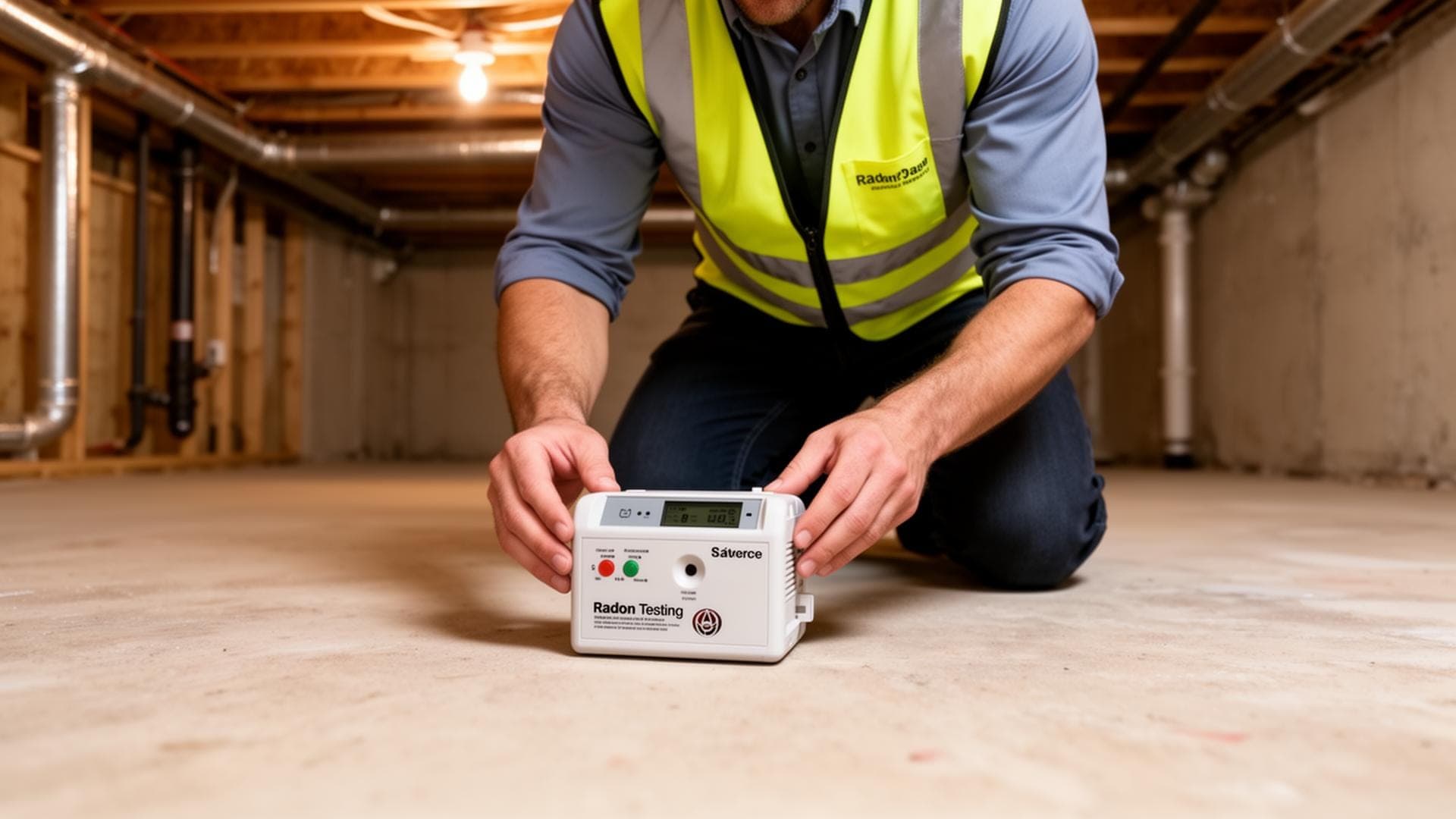
The ideal time to test for radon is before your baby arrives. This gives you time to identify a problem and fix it while you are still in the planning and preparation phase. Here is a practical timeline:
Second Trimester (Ideal)
Testing in the second trimester gives you plenty of time. A short-term test takes 2 to 7 days. If results are elevated, you have months to schedule and complete mitigation before the baby arrives.
Third Trimester (Still Doable)
Even in the third trimester, there is time. A 48-hour test plus a one-day mitigation installation means you can go from untested to fully protected in under two weeks.
After Baby is Born
If you missed testing during pregnancy, test now. Newborns spend nearly all their time indoors, and their developing lungs are more vulnerable. Learn more about how radon affects children. Better late than never.
New Home Purchase
If you are buying a new home before baby arrives, insist on a radon test as part of the home inspection. This is standard practice and gives you negotiating power if levels are elevated.
6. Fast Solutions: Mitigation Timeline
One of the most reassuring things about radon is that the solution is fast and highly effective. Unlike many home environmental issues that take weeks or months to resolve, radon mitigation is typically a one-day job.
A sub-slab depressurization system is the most common and effective mitigation method. A professional radon contractor installs a pipe through the foundation slab and connects it to a fan that continuously pulls radon from beneath the house and vents it safely above the roofline.
The results are dramatic. Most systems reduce indoor radon levels by 95 to 99%. A home testing at 8 pCi/L can drop to below 1 pCi/L within 24 hours of the system being turned on.
From Discovery to Protection
Day 1 to 2: Short-term radon test placed in your home.
Day 3 to 7: Test results received.
Day 8 to 14: Mitigation system installed (typically in one day).
Day 15: Post-mitigation test confirms low levels.
Total time from test to confirmed protection: about two weeks.
The cost for a standard mitigation system in Georgia typically ranges from $1,200 to $2,500. For the peace of mind it provides during pregnancy and throughout your child's life, it is one of the most cost-effective home safety investments you can make. For a deeper understanding of the health risks, see our complete radon and lung cancer risk guide. You can also learn about the difference between short-term and long-term radon testing to find the best option for your timeline.