Basement Radon in Marietta
Sub-Slab Depressurization for Cobb County Basements
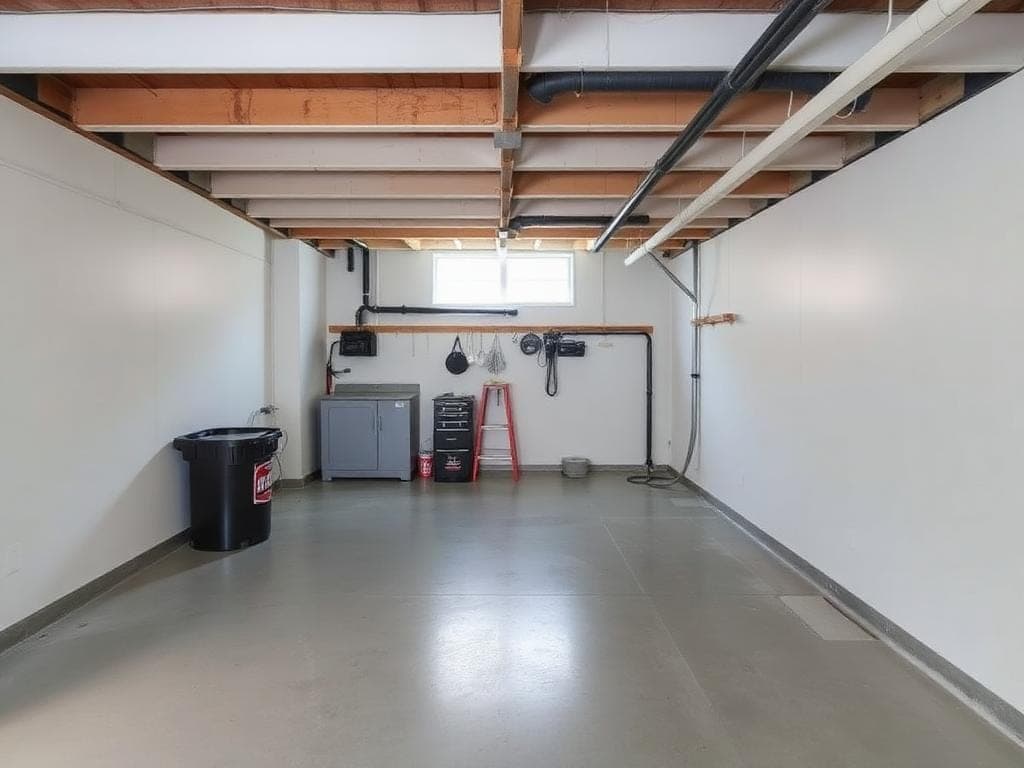
Many older Marietta homes have full basements. Professional mitigation draws radon from beneath your basement floor before it enters your living space.
Why Basements Have Higher Radon
Basements are particularly vulnerable to radon accumulation due to their construction and location.
Direct Soil Contact
Basement floors and walls are in direct contact with soil, providing multiple entry points for radon gas.
Negative Pressure
Basements often have lower air pressure than surrounding soil, drawing radon in through cracks and gaps.
Limited Ventilation
Finished basements may have reduced air exchange, allowing radon to accumulate to higher levels.
Foundation Cracks
Older Cobb County homes often have settlement cracks that provide easy pathways for radon entry.
Basement Mitigation Process
Assessment
We evaluate your basement construction, identify entry points, and determine optimal suction point locations.
Core Drilling
A 4-5 inch hole is drilled through the basement floor slab to access the gravel bed beneath.
Pit Creation
Material is removed beneath the slab to create a suction pit for effective radon collection.
System Installation
PVC piping connects the suction point to a radon fan that vents above the roofline.
Marietta Basement Homes
Many homes in established Marietta neighborhoods like East Cobb and areas near Kennesaw Mountain have full or partial basements. These homes, often built in the 1970s-1990s, may have settling cracks and other radon entry points that develop over time. Those same cracks can let in foundation moisture; if that has caused mold, our sister company Erase Mold provides Marietta basement mold removal.
Basement Radon FAQs
Why do basements have higher radon levels?
Basements are surrounded by soil on multiple sides, providing more surface area for radon entry. The stack effect in homes also draws soil gases upward into basement spaces.
Should I test my finished basement for radon?
Yes. Finished basements used as living space should always be tested. If you spend significant time in your basement, radon exposure matters just as much as in upper floors.
How does basement radon mitigation work in Marietta?
Most Marietta basements use sub-slab depressurization. We drill through the concrete floor, create a suction point, and install a fan system that draws radon from beneath the slab and vents it safely above your roof.
What about radon in my sump pit?
Sump pits are common radon entry points. We seal sump lids with airtight covers and may use the sump pit as a suction point or install a separate suction point nearby.
How much does basement radon mitigation cost in Marietta?
Basement systems in Marietta typically cost $1,000-$2,000 depending on basement size, number of suction points needed, and pipe routing complexity.
Will the system affect my finished basement?
We design systems to minimize visual impact. Pipes can often run through closets, utility areas, or along walls. Exterior routing is also an option.
Protect Your Basement
Contact us to discuss radon testing and mitigation for your Marietta basement.
Related Topics
Radon Testing
Test your basement before and after mitigation
Mitigation Systems
Sub-slab systems for Marietta basements
Mitigation Cost
Basement systems typically $1,000-$2,000
Crawl Space Radon
For homes with combination foundations
Slab Foundation
For homes without basements
Radon Safety Resources
Expert insights and guides to keep you informed
Radon Levels Chart: What Every Reading Means, From 0.4 to 20+ pCi/L
A radon levels chart from 0.4 to 20+ pCi/L. What each reading means, the EPA lifetime lung cancer risk at every level for smokers and never-smokers, the WHO reference level, and exactly what to do next at your number.
Read more about Radon Levels Chart: What Every Reading Means, From 0.4 to 20+ pCi/L →
Radon in Holly Springs, Georgia: A Cherokee County Homeowner Guide
A local guide for Holly Springs and Cherokee County homeowners. Why north-Georgia granite geology produces elevated indoor radon in many homes, why every home should be tested regardless of zone, and how testing and mitigation work.
Read more about Radon in Holly Springs, Georgia: A Cherokee County Homeowner Guide →
Radon in Athens, Georgia: An Athens-Clarke County Homeowner Guide
A local guide for Athens and Athens-Clarke County homeowners, landlords, and renters. Why north-Georgia geology produces elevated indoor radon in many homes, why every home and rental should be tested regardless of zone, and how testing and mitigation work.
Read more about Radon in Athens, Georgia: An Athens-Clarke County Homeowner Guide →