Crawl Space Radon Mitigation in Johns Creek, GA
Sub-membrane depressurization for Shakerag, Newtown, and older Johns Creek homes
Effective radon reduction with moisture and air-quality benefits. Installation ranges $1,800 to $3,500.
Why Johns Creek Crawl Spaces Are Higher Risk
Direct Soil Exposure
Unlike slab homes where concrete provides some barrier, Johns Creek crawl spaces often have exposed dirt floors. Radon from the North Fulton granite below has a direct path into the home through the floor system above.
North Fulton Clay Soils
Johns Creek clay soils hold moisture, and crawl spaces are naturally damp. Moisture carries radon more effectively and creates conditions where radon concentrations build up before migrating into living spaces.
Stack Effect
Warm air rising in larger Johns Creek executive homes creates strong negative pressure that pulls soil gas through the crawl space upward. Two-story and three-story homes experience this more intensely during heating season.
Multiple Entry Points
Crawl spaces combine exposed soil, foundation wall joints, HVAC penetrations, and gaps around plumbing and electrical. Each is a radon entry path. Without encapsulation and active depressurization, all contribute to indoor radon levels.
Sub-Membrane Depressurization Process
Crawl Space Assessment
We inspect the Johns Creek crawl space for access, soil conditions, foundation walls, existing vapor barriers, HVAC, and plumbing penetrations. Many Shakerag and Newtown homes have partial crawl spaces that require careful planning.
Membrane Installation
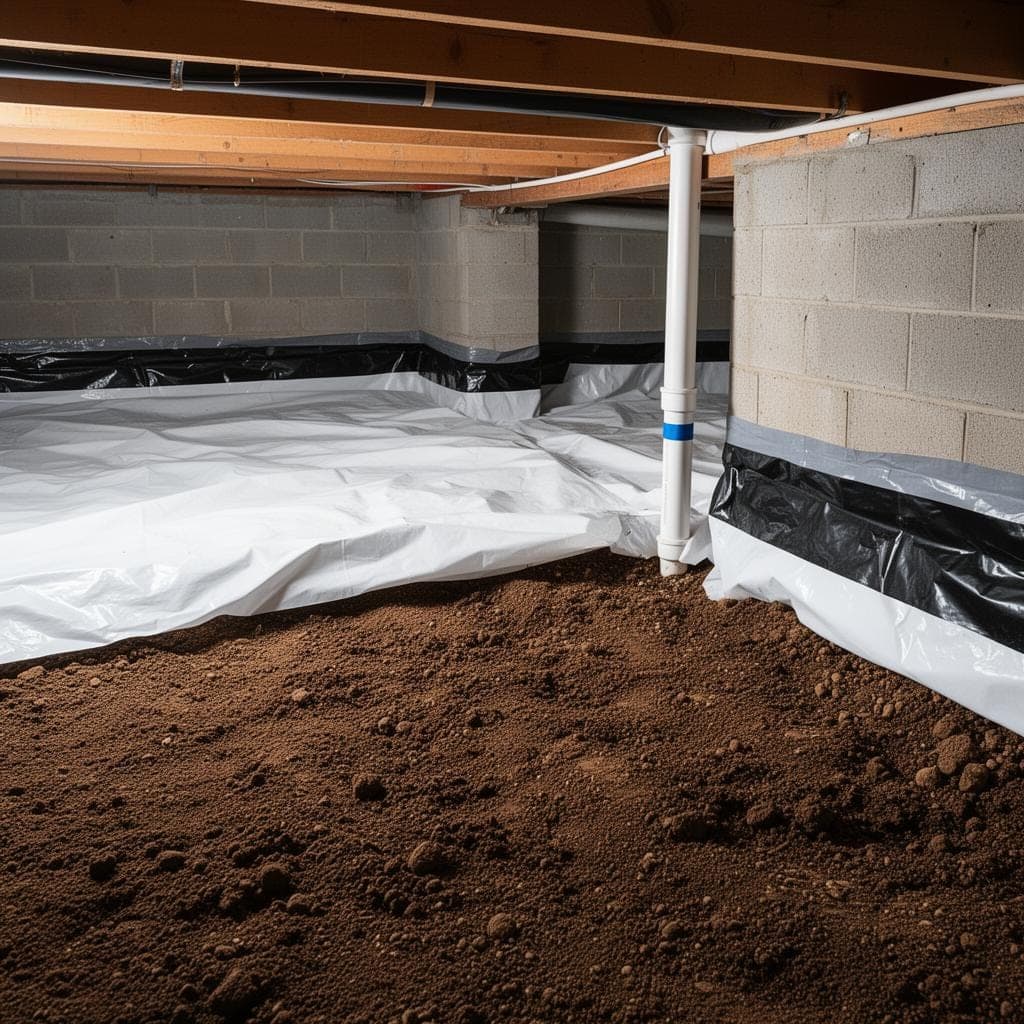
A heavy polyethylene membrane (typically 12-20 mil) is laid over the crawl space floor and sealed to the foundation walls. Seams are overlapped and taped. This creates an airtight barrier between soil and home.
Suction Point and Piping
One or more suction points are cut beneath the membrane. A PVC pipe routes from below the membrane, through the crawl space, and above the roofline. An inline radon fan creates constant negative pressure.
Seal and Verify
All membrane edges, seams, and penetrations are sealed. A post-installation test confirms levels are below 4.0 pCi/L, typically well below 2.0. We also install a manometer for ongoing monitoring.
Johns Creek Crawl Space Areas We Serve
Shakerag
Historic Shakerag has older homes and custom builds with crawl space foundations. Some of these have deteriorated vapor barriers or sections that were never sealed to foundation walls.
Newtown / Old Alabama Road
Older established homes in the Newtown area often have crawl spaces. Many were built before vapor barriers were standard, making them higher priority for mitigation.
Johns Creek Older Subdivisions
Established subdivisions built in the 1970s and 1980s often have crawl space or combination foundations. Decades of settling and vapor barrier degradation means radon entry points multiply over time.
Custom Homes Near the Chattahoochee
Rivermont and other custom homes near the river sometimes use crawl space foundations for sloped lots. These often benefit from sub-membrane mitigation with multiple suction points.
Crawl Space vs. Other Foundations
| Foundation | Cost | System | Why Different |
|---|---|---|---|
| Crawl Space | $1,800 - $3,500 | Sub-Membrane Depressurization (SMD) | Membrane installation adds material and labor. Working in confined Johns Creek crawl spaces takes time. |
| Slab-on-Grade | $1,100 - $2,000 | Sub-Slab Depressurization (SSD) | No membrane needed. Core through slab, install pipe and fan. Much simpler installation. |
| Basement | $1,200 - $2,500 | Sub-Slab Depressurization (SSD) | Similar to slab but may need longer pipe runs. Finished basements add complexity. |
| Combination | $2,500 - $4,500 | Multi-Point System | Both SSD and SMD techniques. Multiple suction points for different foundation sections. |
Benefits Beyond Radon Reduction
Radon Reduction
The primary goal. Sub-membrane depressurization captures radon before entry. Reduces radon levels by up to 99%, typically below 2.0 pCi/L.
Moisture Control
Sealed membrane prevents ground moisture from entering the crawl space. Combined with fan depressurization, moisture is actively drawn away.
Pest Deterrent
Properly sealed membrane creates a physical barrier against pests that would otherwise enter through exposed soil.
Indoor Air Quality
Crawl space air contributes to overall home air quality through the stack effect. Encapsulation improves air quality throughout the house.
Energy Efficiency
Reducing moisture and uncontrolled air infiltration helps HVAC systems run more efficiently. Some Johns Creek homeowners notice improved first-floor comfort.
Structural Protection
Chronic crawl space moisture damages floor joists and subflooring over decades. The membrane and depressurization protect these structural components.
If moisture control rather than radon is your main concern, our sister company Erase Mold installs crawl space encapsulation systems as well.
Johns Creek Crawl Space FAQs
Why does crawl space mitigation cost more than slab in Johns Creek?
Crawl space mitigation requires installing a heavy-duty polyethylene membrane over the entire crawl space floor and sealing it to the foundation walls before depressurization works. This adds significant material cost and labor time. Working in Johns Creek crawl spaces with limited clearance is also physically demanding. Typical Johns Creek crawl space mitigation runs $1,800 to $3,500 compared to $1,100 to $2,000 for slab-on-grade.
Can I use my existing vapor barrier for radon mitigation?
In most cases, no. Standard 6-mil vapor barriers in Johns Creek crawl spaces were installed for moisture, not radon. They have gaps, seams that are not taped, and edges that are not sealed to the walls. Sub-membrane depressurization requires a properly sealed system. We typically install new 12-20 mil membrane with taped seams and fully sealed edges.
How long does crawl space mitigation take?
A typical Johns Creek crawl space mitigation takes 6 to 10 hours, usually a single day. Larger crawl spaces, difficult access, or multiple suction points can extend the timeline. The system begins working immediately after installation.
Does crawl space encapsulation replace radon mitigation?
No. Encapsulation (sealing the space with a vapor barrier) helps with moisture but is not sufficient for radon reduction. Radon mitigation requires active depressurization: sealed membrane plus a fan creating continuous negative pressure beneath. Encapsulation without depressurization can actually concentrate radon under the membrane.
Will mitigation help with moisture in my Johns Creek crawl space?
Yes. The sealed membrane and active depressurization system addresses moisture as a secondary benefit. Many Johns Creek homeowners notice reduced musty odors, lower crawl space humidity, and less condensation after installation. North Fulton clay soils hold significant moisture, so this benefit is often noticeable.
My Johns Creek crawl space has limited access. Can it still be mitigated?
Yes, though limited access may affect timeline and cost. We work in crawl spaces as low as 18 inches, though tighter spaces take more time. If access is very restricted we discuss options during the free assessment. In some cases an access opening may need enlargement.
How does North Fulton clay soil affect radon in crawl spaces?
North Fulton clay soils are significant for two reasons. First, clay holds moisture, creating damp crawl space conditions that carry radon more effectively. Second, clay can crack during dry periods, creating additional radon pathways. Combined with Johns Creek's Piedmont granite radon source, crawl space mitigation is particularly valuable in this area.
Can I combine mitigation with existing dehumidifier systems?
Yes. If you already have a crawl space dehumidifier, the radon mitigation system complements it. The sealed membrane reduces moisture load on the dehumidifier, and depressurization handles radon. Both operate simultaneously. In some cases the mitigation system reduces moisture enough that the dehumidifier runs less often.
Schedule Your Johns Creek Crawl Space Assessment
Free assessment and quote for Johns Creek crawl space mitigation.
More Johns Creek Radon Information
Johns Creek Overview
Full overview of radon services in Johns Creek
Johns Creek Testing
Test before you mitigate
Alpharetta Crawl Space
Compare approach in neighboring Alpharetta
Roswell Crawl Space
Crawl space mitigation in Roswell
Marietta Crawl Space
Services in neighboring Marietta
Suwanee Radon
Services in neighboring Suwanee
Radon Safety Resources
Expert insights and guides to keep you informed
Radon Levels Chart: What Every Reading Means, From 0.4 to 20+ pCi/L
A radon levels chart from 0.4 to 20+ pCi/L. What each reading means, the EPA lifetime lung cancer risk at every level for smokers and never-smokers, the WHO reference level, and exactly what to do next at your number.
Read more about Radon Levels Chart: What Every Reading Means, From 0.4 to 20+ pCi/L →
Radon in Holly Springs, Georgia: A Cherokee County Homeowner Guide
A local guide for Holly Springs and Cherokee County homeowners. Why north-Georgia granite geology produces elevated indoor radon in many homes, why every home should be tested regardless of zone, and how testing and mitigation work.
Read more about Radon in Holly Springs, Georgia: A Cherokee County Homeowner Guide →
Radon in Athens, Georgia: An Athens-Clarke County Homeowner Guide
A local guide for Athens and Athens-Clarke County homeowners, landlords, and renters. Why north-Georgia geology produces elevated indoor radon in many homes, why every home and rental should be tested regardless of zone, and how testing and mitigation work.
Read more about Radon in Athens, Georgia: An Athens-Clarke County Homeowner Guide →