The short answer
Warehouses and industrial buildings can have radon because they sit on huge slabs in direct contact with the soil, and soil is where radon comes from. Slab cracks, control joints, and floor penetrations give soil gas a way in, and low fresh-air ventilation lets it accumulate where workers spend their shifts at ground level. Owners test for employee safety and duty of care, and during a purchase, refinance, or lease. Testing covers the open floor with devices spread across it plus common-area offices, the action level is 4.0 pCi/L, and anything at or above that gets mitigated, usually with multiple sub-slab suction points, and then retested.
Table of contents
- 1. Why warehouses and industrial buildings get radon
- 2. Workers spend shifts at ground level
- 3. Why owners test: safety, financing, leasing
- 4. Employer duty of care and the OSHA general duty clause
- 5. How testing a large open footprint works
- 6. The 4.0 pCi/L action level
- 7. Mitigation at industrial scale
- 8. Radon risk in metro Atlanta
- 9. Frequently asked questions
1. Why warehouses and industrial buildings get radon
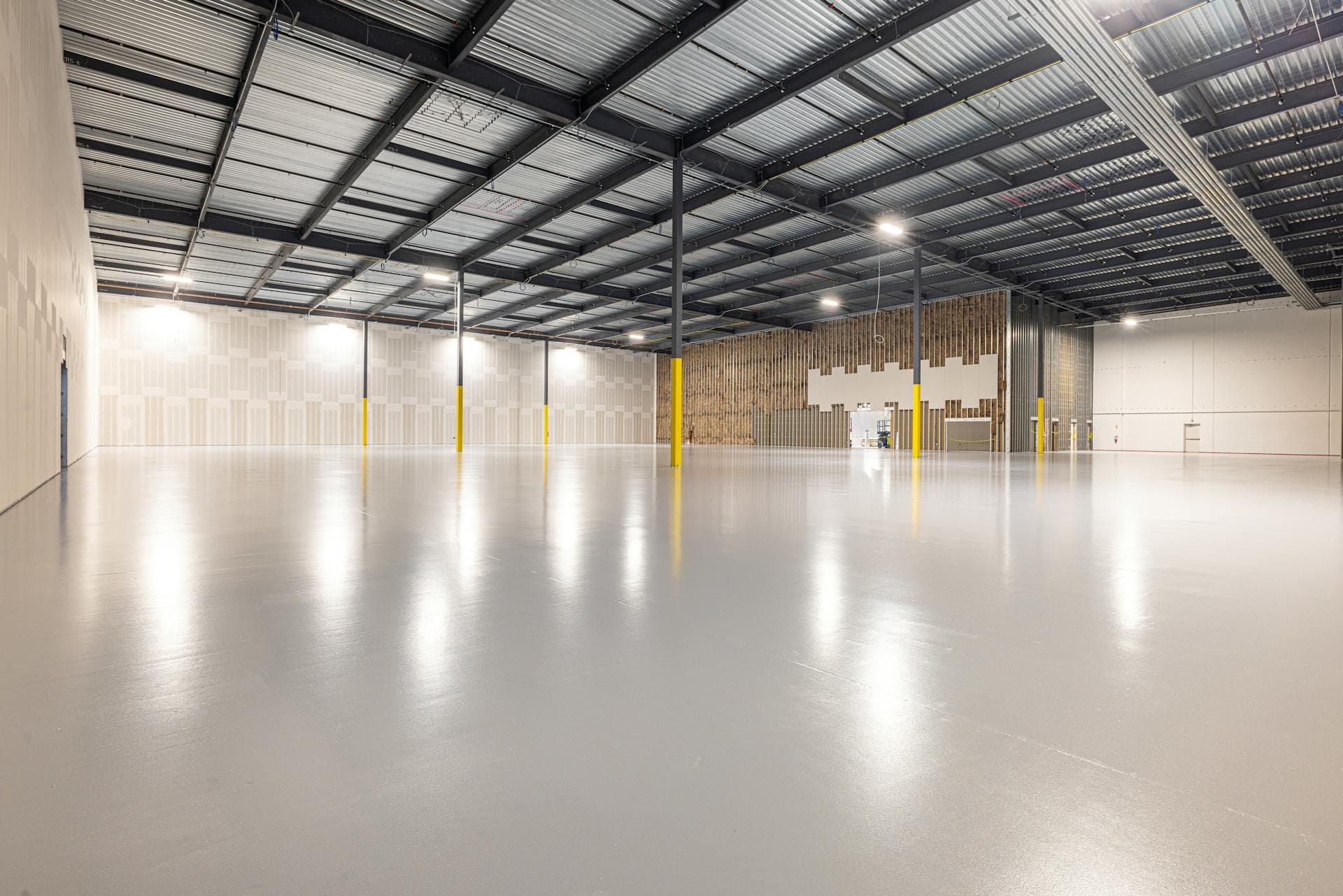
Radon is a naturally occurring gas that forms as uranium in soil and rock breaks down. It seeps up out of the ground and enters buildings through whatever contact they have with the soil beneath them. That is the key to why warehouses and industrial buildings deserve attention: they have an enormous ground-contact footprint. A single distribution center can cover hundreds of thousands of square feet of slab, and every square foot of that slab is a surface where soil gas can push through.
Slab-on-grade construction is the norm for this building type, which means the floor is poured directly over the soil with no basement or crawl space in between. Over time, concrete slabs develop shrinkage cracks and control joints, and they are penetrated for plumbing, drains, sumps, electrical conduit, and equipment anchors. Each crack and penetration is a pathway. A large slab simply has more of them than a small building does.
Ventilation works against you here too. Many warehouse and industrial spaces run with limited fresh-air exchange to control heating and cooling costs, and the indoor pressure can pull soil gas upward through the slab. When low fresh-air ventilation meets a large ground-contact footprint, radon has both a way in and a place to accumulate. High ceilings dilute the gas in the upper volume, but the air people actually breathe is at floor level.
2. Workers spend shifts at ground level
Radon risk is about how much you breathe and for how long. In a warehouse or plant, the people who pick orders, run forklifts, work production lines, and staff shipping and receiving spend full shifts at floor level, right where soil gas enters. That is a meaningful exposure window, repeated day after day. Radon is the second leading cause of lung cancer in the United States, so a workforce spending long hours at ground level in an elevated building is the population that matters most.
Attached and interior offices, break rooms, locker rooms, and security stations are also at ground level and are often more tightly enclosed than the open warehouse floor, which can let radon concentrate in those smaller spaces. Those are the areas where staff sit still for long stretches, so they deserve their own measurements rather than an assumption that the open bay reading covers them.
3. Why owners test: safety, financing, and leasing
The first reason is employee safety. Owners and operators who take duty of care seriously want to know whether the people working in their building are breathing elevated radon, because it is an invisible, odorless hazard that only a test can reveal. Once you know a number, you can act on it.
The second reason is transactions. Radon shows up in due diligence when an industrial property is bought, sold, or refinanced. A lender, an insurer, or an environmental consultant may ask for radon results, and a buyer wants to know about a potential mitigation cost before closing rather than after. Getting ahead of testing keeps a finding from becoming a last-minute negotiation or a closing delay.
The third reason is leasing. Tenants, especially larger or more sophisticated ones, increasingly ask environmental questions before they sign, and a landlord who can show recent radon results is in a stronger position. For owners evaluating a building across these scenarios, our commercial radon testing guide walks through the process end to end.
4. Employer duty of care and the OSHA general duty clause
Employers have a general duty to provide a workplace free of recognized serious hazards. That principle is captured in the OSHA general duty clause, which requires employers to keep their workplaces free from recognized hazards that are causing or likely to cause death or serious physical harm. Radon is a recognized lung-carcinogen, so for many owners testing fits squarely within that broader duty of care to their workforce.
This article frames employer responsibility through the general duty clause and ordinary duty of care, not a specific numeric workplace limit. Workplace obligations vary by operation and jurisdiction, so confirm what applies to your facility with your own safety or legal advisor.
The takeaway is practical rather than legal. You do not need a state radon statute, and Georgia does not have one for commercial buildings, to have a sound reason to test. Knowing whether your people are breathing elevated radon, and fixing it if they are, is the responsible position regardless of whether a specific rule forces your hand.
5. How testing a large open footprint works
Testing a home usually means one device in the lowest lived-in area. A warehouse is a different problem. The floor is so large that radon can vary widely across it, with one corner reading clean and another reading high, depending on the soil, the slab condition, and where the penetrations are. So instead of a single device, a large open footprint is covered with multiple measurement devices distributed across the floor area. The goal is to map the building, not to take its temperature in one spot.
Placement follows the people and the building's geometry. Devices go where workers spend time, such as packing and assembly stations, and they are also placed in the common-area offices, break rooms, and other enclosed ground-level spaces that can concentrate radon. Devices are positioned away from drafts, exterior doors, and direct airflow so the readings reflect normal conditions. The building usually keeps operating during the measurement window.
Testing should follow recognized measurement practice. The American Association of Radon Scientists and Technologists (AARST) publishes the consensus ANSI/AARST protocols used for measuring radon in large and commercial buildings, and a defensible report references the protocol it followed. When you choose a provider, the question to ask is whether the testing is performed to the current ANSI/AARST standard rather than with a generic home kit. You can review the published standards through the AARST standards library.
6. The 4.0 pCi/L action level
The widely used radon action level is 4.0 pCi/L (picocuries per liter), the same threshold applied across most US radon programs. If a tested area reads at or above 4.0 pCi/L, the standard response is to mitigate, and the work is not considered complete until post-mitigation testing confirms the level has dropped below 4.0 pCi/L. That mitigate-then-retest loop is what turns a high reading into a documented fix.
It helps to be precise about what the action level means. It is the point at which action is recommended, not a clean line between safe and dangerous. Radon risk is continuous, so a building reading just under 4.0 pCi/L still carries some risk, and some owners of long-occupied workplaces choose to reduce levels further when the cost is reasonable.
7. Mitigation at industrial scale
Mitigating a warehouse uses the same core method as a house, sub-slab depressurization, just scaled up. The system creates suction beneath the slab so that soil gas is drawn into the system and vented above the roofline before it can enter the workspace. The difference is footprint. A house might need a single suction point, while a large industrial slab usually needs multiple suction points distributed across the floor and tied into a manifold with one or more fans sized for the building.
How many suction points a building needs depends on the slab. The condition of the sub-slab fill, how well air communicates beneath the slab, the presence of footings or grade beams that divide the area, and the locations of high readings all shape the design. A diagnostic step, often a sub-slab communication test, informs how many points are required and where they go. Sealing major cracks and penetrations is part of the work because it helps the system hold suction across the whole slab.
After installation, the building is retested to confirm levels are below 4.0 pCi/L. A properly designed industrial system runs quietly in the background and does not interfere with operations once it is commissioned. Because every slab is different, a firm mitigation design and price come after testing and a site visit rather than from a square-foot rule of thumb.
8. Radon risk in metro Atlanta
Georgia does not have a state radon testing law, which leads some owners to assume radon is not a local concern. The geology says otherwise. On the EPA Map of Radon Zones, four metro Atlanta counties, Fulton, Cobb, DeKalb, and Gwinnett, are Zone 1, the highest category, meaning a predicted indoor average at or above 4.0 pCi/L. Several surrounding north Georgia counties also carry elevated designations driven by the region's granite and uranium-bearing bedrock. Much of the metro's industrial inventory sits in exactly these areas.
The EPA zone map predicts averages by county. It does not tell you whether a specific building is elevated, and EPA advises testing no matter which zone you are in. A Zone 1 county is not a guarantee of high radon, and a lower zone is not a guarantee of safety. The only way to know a building is to test it.
For a warehouse or industrial building in metro Atlanta, the combination of a large ground-contact footprint and genuinely elevated regional radon means high results are common enough to plan for. EraseRadon works with industrial and commercial property owners across the metro on testing and mitigation. For an overview of how we approach larger properties, see our commercial radon services.
9. Frequently asked questions
This article is general information for property owners and managers, not legal, financial, or engineering advice. Workplace obligations, ANSI/AARST standards, and lender and tenant policies change over time and vary by operation. Confirm the requirements that apply to your property and workforce with your own advisors and a qualified radon professional before making decisions.