The short answer
Self-storage is an overlooked radon asset class. The buildings sit on large slab-on-grade footprints in direct contact with the soil, often run with low ventilation, and increasingly include sealed climate-controlled space where people and goods sit for hours. Radon rarely comes up because of a storage-specific law. It comes up during acquisitions and Phase I due diligence, from occupant inquiries, or because a building is climate-controlled. Testing places devices across the slab footprint and conditioned zones for a set period; the EPA action level of 4.0 pCi/L is the third-party threshold most consultants and lenders apply, and elevated results are mitigated with a sub-slab system and retested.
Table of contents
- 1. Why self-storage is its own radon problem
- 2. Slab-on-grade, low ventilation, and ground contact
- 3. Climate-controlled buildings change the picture
- 4. Why radon comes up for storage operators
- 5. Acquisitions and Phase I due diligence
- 6. How testing a storage facility works
- 7. Mitigation considerations for storage buildings
- 8. Radon risk in metro Atlanta
- 9. Frequently asked questions
1. Why self-storage is its own radon problem
Most radon writing is about homes, apartments, and offices, buildings where people clearly spend hours every day. Self-storage tends to fall through that gap. Owners assume that because customers come and go quickly, radon is not their concern, and there is very little content written specifically for the asset class. That gap is exactly why it deserves a closer look.
The building physics that drive indoor radon do not care whether a space is a bedroom or a storage bay. Radon is a soil gas that enters through the floor in contact with the ground, and how much accumulates depends on the size of that ground contact and how much fresh air dilutes it. Self-storage scores high on the first factor and low on the second, which is why it can read elevated even when no one expects it to.
The owners who care most are the ones treating storage as an institutional asset: operators expanding a portfolio, REITs acquiring at scale, and private buyers underwriting a single facility. For all of them, radon is a question that surfaces inside the deal rather than something they go looking for, and being ready for it keeps it from becoming a surprise.
2. Slab-on-grade, low ventilation, and ground contact
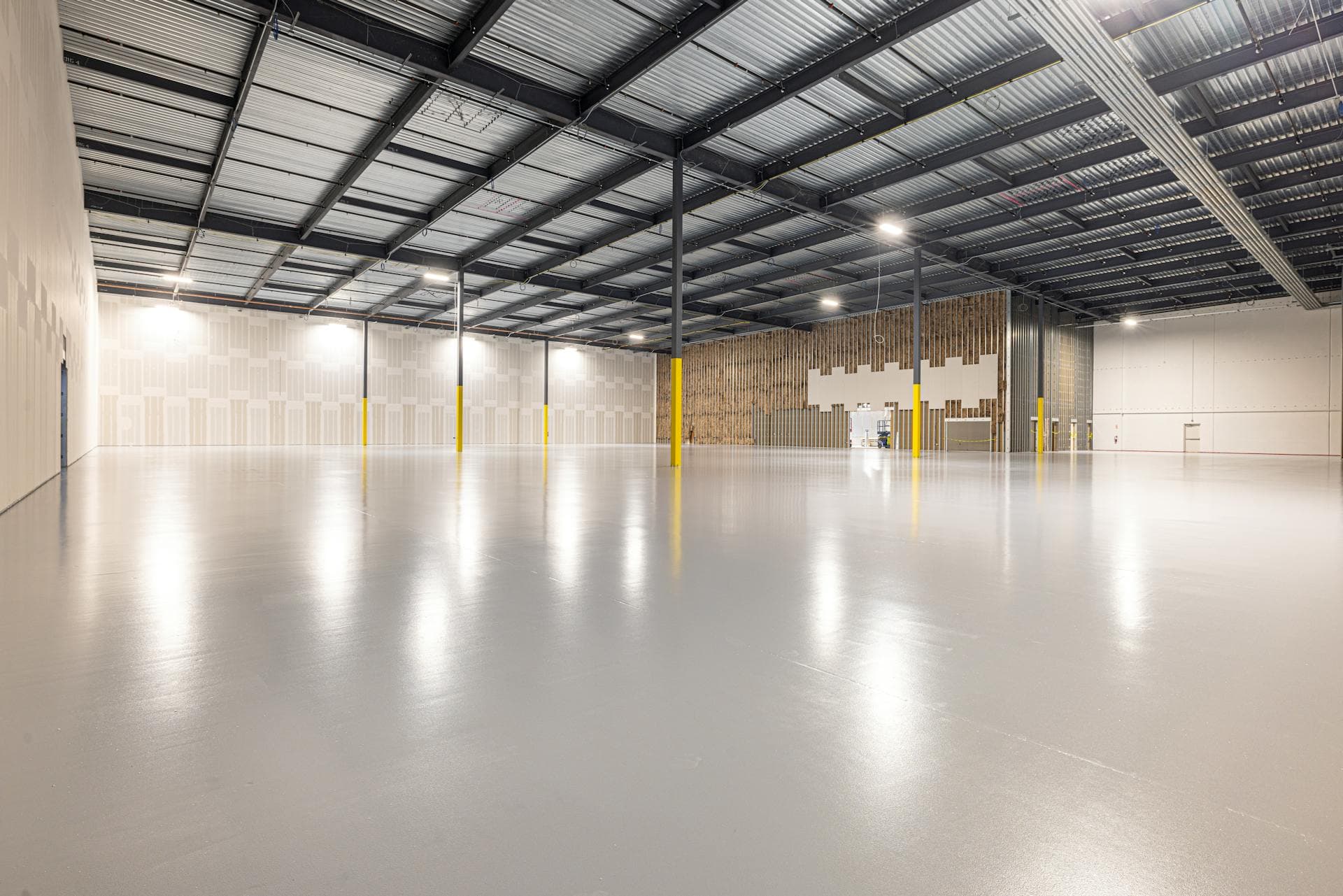
Self-storage is almost always slab-on-grade construction. A large concrete slab is poured directly on the prepared soil, and the storage units sit on top of it. That means the entire footprint of the building is a ground-contact surface, and every crack, control joint, slab penetration, and gap at the slab edge is a potential entry point for soil gas. A sprawling single-story storage building can present far more ground-contact area than a comparable multi-story building on a small foundation.
The second half of the problem is ventilation. Storage buildings are designed to be closed and stable, not constantly ventilated. Drive-up units are opened briefly and then sealed again, and interior corridor units may see very little air movement for long stretches. Where a busy office cycles its air many times an hour, a storage building can sit largely still. Soil gas that enters has little fresh air to dilute it, so concentrations can climb instead of being swept out.
Large ground contact plus low air turnover is the same combination that drives elevated radon in basements. A storage building can carry both at once across a very large slab, which is why assuming a transient-use building is automatically low-radon is a mistake. The only way to know is to test.
3. Climate-controlled buildings change the picture
Climate-controlled storage is now a large and growing share of the inventory, and it changes the radon calculus in two ways. First, these buildings are deliberately sealed and conditioned. Tighter construction and controlled airflow reduce the uncontrolled leakage that would otherwise dilute indoor air, which can let soil gas that enters stay inside longer rather than being vented away.
Second, climate-controlled space is where people actually spend time. Customers store sensitive belongings there and visit those units more often and for longer. Staff move through conditioned corridors, and offices and leasing counters are typically conditioned space too. Once you have people sitting or working in a space for hours, the exposure question is no longer hypothetical, and the same conditioned zones that protect stored goods are the zones most worth measuring.
4. Why radon comes up for storage operators
For storage owners, radon does not usually arrive as a standing legal requirement. It tends to surface through one of three doors. The first is a transaction. When a facility is bought, sold, or refinanced, an environmental review can put radon on the table, especially where a lender or a consultant flags it.
The second is an occupant inquiry. A tenant, an employee, or a prospective customer asks whether the building has been tested, often because they have read about radon in the news or because they are storing items in a climate-controlled unit they visit frequently. A documented test answers that question cleanly and protects the operator from looking like they ignored it.
The third is the building itself. As soon as a facility includes climate-controlled space where people and goods sit for hours, the operator has moved from pure drive-up transient use toward something closer to occupied commercial space. That is the moment many thoughtful owners decide to test proactively rather than wait for someone else to ask.
5. Acquisitions and Phase I due diligence
The most common way radon enters a storage deal is the Phase I Environmental Site Assessment. A Phase I is the standard environmental screen a buyer or lender orders during commercial acquisitions. Radon is not always part of a baseline Phase I scope, but it is a frequent add-on, and many consultants and lenders will recommend radon testing for a slab-on-grade building in a higher-radon area, which describes a great deal of metro Atlanta self-storage.
For an acquirer or a REIT moving on a portfolio, the practical risk is timing. If radon testing is requested late and a building reads high, the result can stall a closing while mitigation is scoped and priced. Building a short radon testing window into the diligence timeline, rather than reacting to it at the end, keeps a high reading from becoming a deal-timing problem. Our commercial radon testing guide walks through how testing fits into a commercial transaction in more detail.
Radon requirements during due diligence are set by the lender, the buyer, or the environmental consultant on a given deal, not by a storage-specific rule. Confirm what the parties on your transaction expect before you order testing, so the scope and the threshold match what the deal needs.
6. How testing a storage facility works
Testing a storage facility is built around the slab and the conditioned space rather than around rooms where people sleep. A measurement plan places devices in representative locations across the ground-contact footprint, concentrated in the climate-controlled zones, the office, and any area where staff or customers spend meaningful time. The goal is to characterize the building, so device placement follows the slab and the airflow, not an arbitrary grid.
Devices are placed under closed-building conditions for the measurement period, then retrieved and sent to a lab. Short-term testing typically runs a minimum of a few days. The deliverable is a written report that records where devices were placed, the levels found, and how those compare to the 4.0 pCi/L action level the EPA recommends and that consultants and lenders generally reference. A multi-building site is simply staged so each building is characterized, which takes more planning but follows the same logic.
Because storage buildings have few permanent occupants, testing is logistically simpler than testing an occupied apartment community. There are no tenants to relocate and no living-unit access to coordinate. The main coordination is around keeping conditions stable during the measurement window and protecting the devices from tampering or relocation.
7. Mitigation considerations for storage buildings
If a building reads at or above the action level, the standard fix for a slab-on-grade structure is active sub-slab depressurization. Suction points are cut into the slab and connected to a riser and a fan that draws soil gas from beneath the slab and exhausts it safely above the roofline, so it never enters the occupied space. On a large storage slab, the engineering question is how many suction points the slab needs and where to route the risers, which depends on the slab construction, the sub-slab material, and the building layout.
The advantage of storage is that mitigation rarely needs to displace anyone. Suction points and riser routing can usually be planned around aisles and unit access, and the work can often proceed while the facility stays open. After installation, the building is retested to confirm the level has come down below the action level, and the system is documented so a future buyer or lender can see that radon was found, addressed, and verified.
For new construction or a planned expansion, it is far cheaper to build in radon-resistant features during the slab pour than to retrofit later. A passive sub-slab system roughed in at construction can be activated with a fan if testing later shows it is needed, which is the lowest-cost path for an operator who is already pouring a new slab.
8. Radon risk in metro Atlanta
Georgia does not have a state radon testing law, which leads some storage owners to assume radon is not a local concern. The geology says otherwise. On the EPA Map of Radon Zones, four metro Atlanta counties, Fulton, Cobb, DeKalb, and Gwinnett, are Zone 1, the highest category, meaning a predicted indoor average at or above 4.0 pCi/L. Several surrounding north Georgia counties also carry elevated designations driven by the region granite and uranium-bearing bedrock.
The EPA zone map predicts county averages. It does not tell you whether a specific storage building is elevated, and the EPA advises testing no matter which zone you are in. A Zone 1 county is not a guarantee of high radon, and a lower zone is not a guarantee of safety. The only way to know a building is to test it.
For a metro Atlanta self-storage facility, the combination of large slab-on-grade footprints, sealed climate-controlled space, and genuinely elevated regional radon means high results are common enough to plan for. Whether you are acquiring, refinancing, or simply answering a customer who asked, testing turns radon from an open question into a documented fact.
9. Frequently asked questions
This article is general information for property owners and managers, not legal, financial, or engineering advice. Radon requirements, testing standards, and lender policies change over time and vary by transaction. Confirm the current requirements that apply to your property with your lender, your environmental consultant, and a qualified radon professional before making decisions.