The short answer
Retail and strip-center buildings are a real radon concern because they sit on large slab-on-grade footprints in direct contact with soil, with many penetrations through the slab, and because staff spend long hours inside. Georgia does not require radon testing for commercial buildings, so the reason owners and tenants test is almost always a transaction or a liability concern: an acquisition or refinance, a Phase I environmental assessment, a lease question, or simple care for the people working in the space. The widely used action level is 4.0 pCi/L. Where readings come back high, mitigation at retail scale is straightforward and is usually planned so the business keeps operating.
Table of contents
- 1. Why retail buildings are a radon concern
- 2. Big slabs, many penetrations, on the soil
- 3. Staff hours and customer exposure
- 4. Who tests, and why: landlords and tenants
- 5. Acquisitions, Phase I ESA, and leasing
- 6. How testing a retail space works
- 7. Mitigation at retail scale
- 8. The Georgia context: no mandate, real risk
- 9. Frequently asked questions
1. Why retail buildings are a radon concern
Radon is a naturally occurring radioactive gas that comes up out of the soil and collects inside buildings that sit on top of it. Most of the public conversation about radon is about homes, but the same physics applies to a strip center, a standalone store, or a restaurant. If a building sits on the ground and people spend time inside it, radon is worth thinking about.
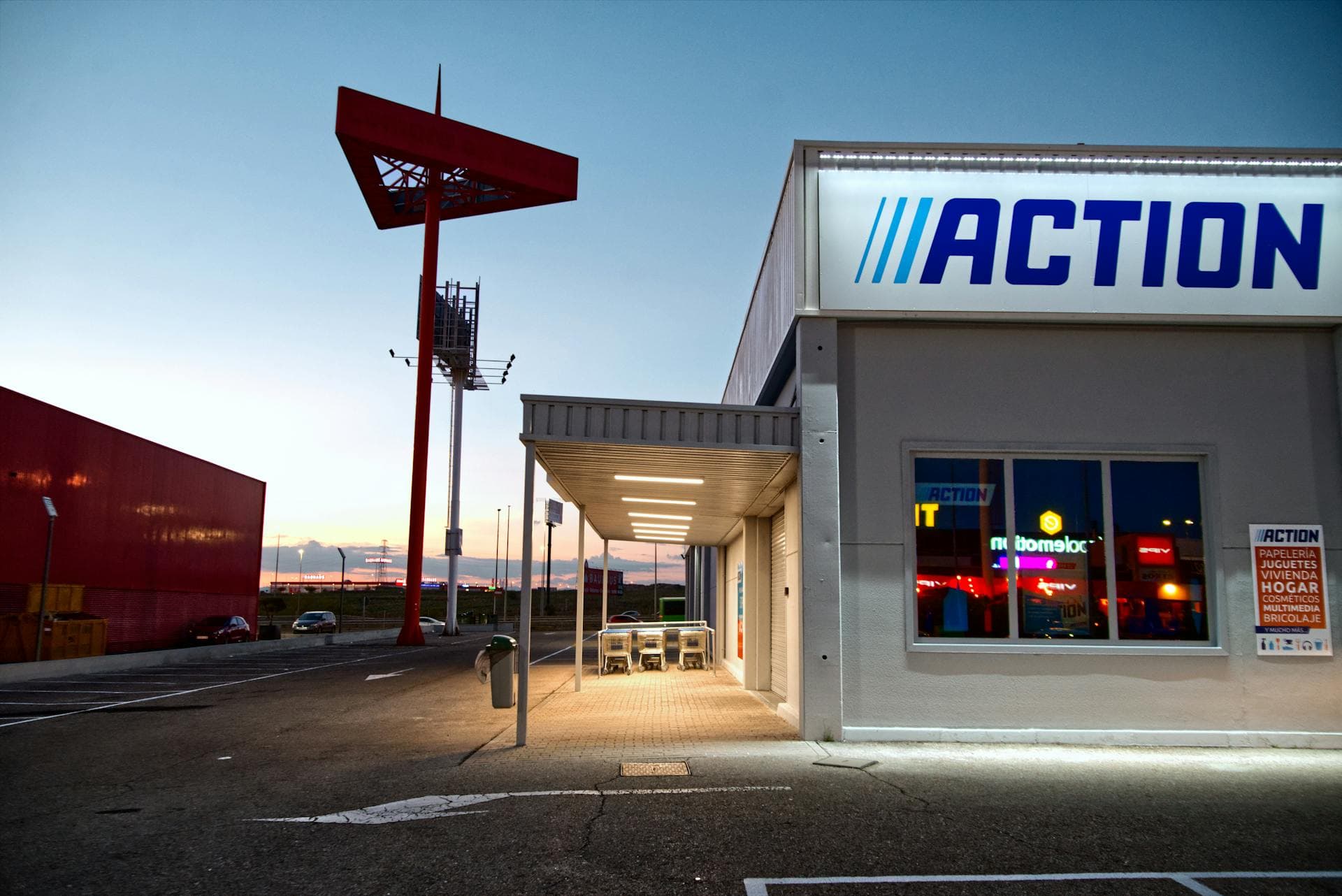
Retail buildings have a particular combination of features that makes them worth testing. They tend to be wide single-story structures on a concrete slab poured directly on the soil. They run mechanical systems that move air and can change the pressure relationship between the building and the ground beneath it. And they are occupied for long stretches by employees who are there shift after shift. None of that is unusual, which is exactly the point: this is an ordinary building type where radon can accumulate and where the exposure falls on workers.
2. Big slabs, many penetrations, on the soil
The defining feature of most retail and strip-center construction is the slab. A large footprint means a large area of concrete in direct contact with the soil, and that soil contact is the doorway radon uses to get inside. The bigger the slab, the more soil the building sits on, and the more opportunity there is for soil gas to enter.
Slabs are also full of penetrations. Plumbing rough-ins for restrooms and break rooms, floor drains, utility chases, expansion joints, control joints, and the perimeter crack where the slab meets the foundation wall all create paths for soil gas. A retail build-out adds more of them every time a tenant changes and a new bathroom or sink gets cut into the floor. Each penetration is a small opening, and collectively they are how radon migrates from the soil into the occupied space.
A slab is not a sealed barrier. Even a sound, modern slab has joints and penetrations, and concrete is slightly permeable to gas. Owners sometimes assume a new building cannot have radon because the slab looks intact. The only way to know is to test the air inside.
Mechanical systems can make this worse. Rooftop HVAC units, exhaust fans, and large open interiors can put the building under slight negative pressure relative to the soil, which actively pulls soil gas up through those penetrations. This is one reason a retail space can read higher than a casual look at the building would suggest.
3. Staff hours and customer exposure
Radon exposure is about time. The longer a person breathes elevated radon, the more the risk adds up. That is why staff exposure is the center of gravity for radon in a retail setting. A cashier, a stylist, a server, a pharmacist, or a shop manager can spend full shifts in the same space, week after week, for years. Their cumulative exposure in a building that reads high is far larger than that of any single customer.
Customers matter too, but their exposure is brief. The strongest reason to test a retail space is the people who work there. For a landlord, those workers are tenants' employees; for a tenant, they are your own staff. Either way, an elevated building puts the people earning a living inside it at the most risk, and testing is the only way to find out whether that risk is present.
4. Who tests, and why: landlords and tenants
Two parties have a stake in a retail space: the landlord who owns the building and the tenant who operates inside it. Both have reasons to care about radon, and the lease usually decides who is responsible for what.
For a landlord, the reasons cluster around the building as an asset and as a place of work. A sale or refinance brings radon into due diligence. A Phase I environmental assessment may recommend testing. A tenant may raise the question, particularly a larger or national tenant with its own environmental standards. And underneath all of it sits a duty to the people who work in the building, which is a liability consideration as much as an ethical one.
For a tenant, the interest is more direct: it is your staff in the space for full shifts. Testing the unit you lease, especially before a long lease term or a build-out, is a reasonable step. Because the lease usually assigns testing and any resulting mitigation to one party or splits it, read the lease and talk to the landlord before ordering work, so the cost and the responsibility are clear up front.
5. Acquisitions, Phase I ESA, and leasing
The most common moment radon testing enters a retail deal is a transaction. When a retail property is bought, sold, or refinanced, the buyer or the lender typically wants environmental due diligence, and a Phase I Environmental Site Assessment is the standard tool. A Phase I is largely a records and site-walk review, and depending on the building and the consultant's judgment it can recommend radon testing as a next step. When that recommendation lands, testing becomes part of closing the deal.
Leasing is the other recurring trigger. A national or institutional tenant may require a radon test as a condition of signing, and a long-term lease is a natural point to establish a baseline for a space where staff will spend years. The cleanest path is to handle radon before the lease is signed, so the result is known to both sides and the responsibility for any mitigation is written into the agreement rather than fought over later.
For the broader picture of how commercial radon testing fits into building deals and operations, see our commercial radon testing guide.
6. How testing a retail space works
Testing a retail space is not disruptive. Small measurement devices are placed in the occupied area, typically in the lowest occupied level where staff spend time, and left for a measurement period before being retrieved and analyzed. The store stays open and operating the whole time. The goal is to measure the air the way the space is actually used, with the HVAC running as it normally does and exterior doors used for ordinary customer traffic rather than propped open.
Placement and sampling are where retail differs from a house. A multi-tenant strip center is effectively several buildings under one roof. Each bay has its own slab contact, its own HVAC, and its own use, and radon can vary from one unit to the next. So testing is generally planned per tenant space rather than as a single building-wide reading. A large single-tenant box may need more than one device to represent different zones of a wide floor plan. The right sampling plan depends on the footprint and on what a lender or buyer is asking the test to demonstrate.
The output is a written report with the measured levels, compared against the 4.0 pCi/L action level published by the EPA. That report is what a lender, a buyer, or a tenant looks at to decide whether mitigation is needed.
7. Mitigation at retail scale
When a retail space reads at or above 4.0 pCi/L, the fix is the same approach used across most building types: sub-slab depressurization. A suction point is cut into the slab, and a fan draws soil gas from beneath the floor and vents it above the roofline, so the radon never enters the occupied space. The system is sized to the slab, and a large retail footprint may need more than one suction point to cover the area effectively.
The retail-specific consideration is keeping the business running and the storefront presentable. Riser routing is planned to stay out of customer sightlines where possible, the fan is positioned to limit noise, and the slab work is scheduled around operating hours. After the system runs, the space is retested to confirm it reads below the action level, and that post-mitigation result is the documentation a lender or buyer wants in the file.
Mitigation cost depends on the slab size, the number of suction points needed, and the building's construction, so a firm number comes after testing and a site visit. Testing is inexpensive by comparison, which is why it makes sense to test first and let the result decide whether mitigation is even on the table.
8. The Georgia context: no mandate, real risk
Georgia does not have a state law that requires radon testing for retail or other commercial buildings. That absence of a mandate leads some owners to assume radon is not a local issue, but the two questions are separate. There is no state rule, and there is genuine local radon risk, and both are true at the same time.
The risk comes from geology, not regulation. Several metro Atlanta counties sit in the highest category on the EPA Map of Radon Zones, driven by the region's granite and uranium-bearing bedrock, and surrounding north Georgia counties carry elevated designations as well. A large slab-on-grade retail building in one of those areas is exactly the kind of structure where elevated readings turn up.
The EPA zone map predicts averages by county. It does not tell you whether a specific building is elevated, and the EPA advises testing regardless of zone. A high-zone county is not a guarantee of high radon, and a lower zone is not a guarantee of safety. The only way to know a building is to test it.
So for a Georgia retail owner or tenant, the practical takeaway is that no one is going to force you to test, but the building geology, the slab footprint, and the staff hours inside all point the same direction. Testing is a small, voluntary step that answers a question you would otherwise be guessing at. For multi-building portfolios and mixed residential and retail assets, the same logic applies to multifamily radon testing, and HUD-financed properties carry their own rules, covered in our guide to HUD radon requirements for multifamily.
9. Frequently asked questions
This article is general information for property owners, managers, and tenants, not legal, financial, or engineering advice. State and federal requirements, lender policies, lease terms, and radon standards change over time. Confirm the current requirements that apply to your property and your lease with the appropriate professionals before making decisions.