The short answer
Gainesville and Hall County sit in north Georgia's Piedmont and Blue Ridge geology, where granite and uranium-bearing bedrock break down and release radon gas into the soil. That gas can seep into homes and build up indoors. Radon is the second leading cause of lung cancer in the United States, and the EPA action level is 4.0 pCi/L. Levels vary house by house, so the EPA advises testing every home regardless of which radon zone it falls in. Testing is inexpensive and quick, and elevated radon is a solvable problem.
Table of contents
- 1. What radon is and why it matters
- 2. Why north Georgia geology raises radon risk
- 3. Why every home should be tested, no matter the zone
- 4. How radon testing works
- 5. The 4.0 pCi/L action level
- 6. What radon mitigation involves
- 7. When Gainesville homeowners should test
- 8. Local context for Hall County
- 9. Frequently asked questions
1. What radon is and why it matters
Radon is a colorless, odorless, radioactive gas that forms naturally as uranium in soil and rock breaks down. You cannot see it, smell it, or taste it, which is why it goes unnoticed in so many homes. It moves up through the ground and can enter a house through cracks in the foundation, gaps around pipes, sump pits, and the joint where the slab meets the foundation wall.
The reason it matters is health. Radon is the second leading cause of lung cancer in the United States, behind smoking, and the leading cause among people who have never smoked. Because the gas is invisible and the health effect builds up quietly over years of exposure, the risk is easy to ignore until a test reveals it. The good news is that radon is measurable and fixable, which puts homeowners in control once they test.
2. Why north Georgia geology raises radon risk
Gainesville sits in the foothills where Georgia's Piedmont meets the Blue Ridge, a region built on granite and other crystalline, uranium-bearing bedrock. Uranium is the parent of radon. As it decays over geologic time, it produces radium and then radon gas, which works its way up through soil and fractured rock toward the surface. Where the underlying rock carries more uranium, the soil above it tends to give off more radon, and that is the situation across much of north Georgia.
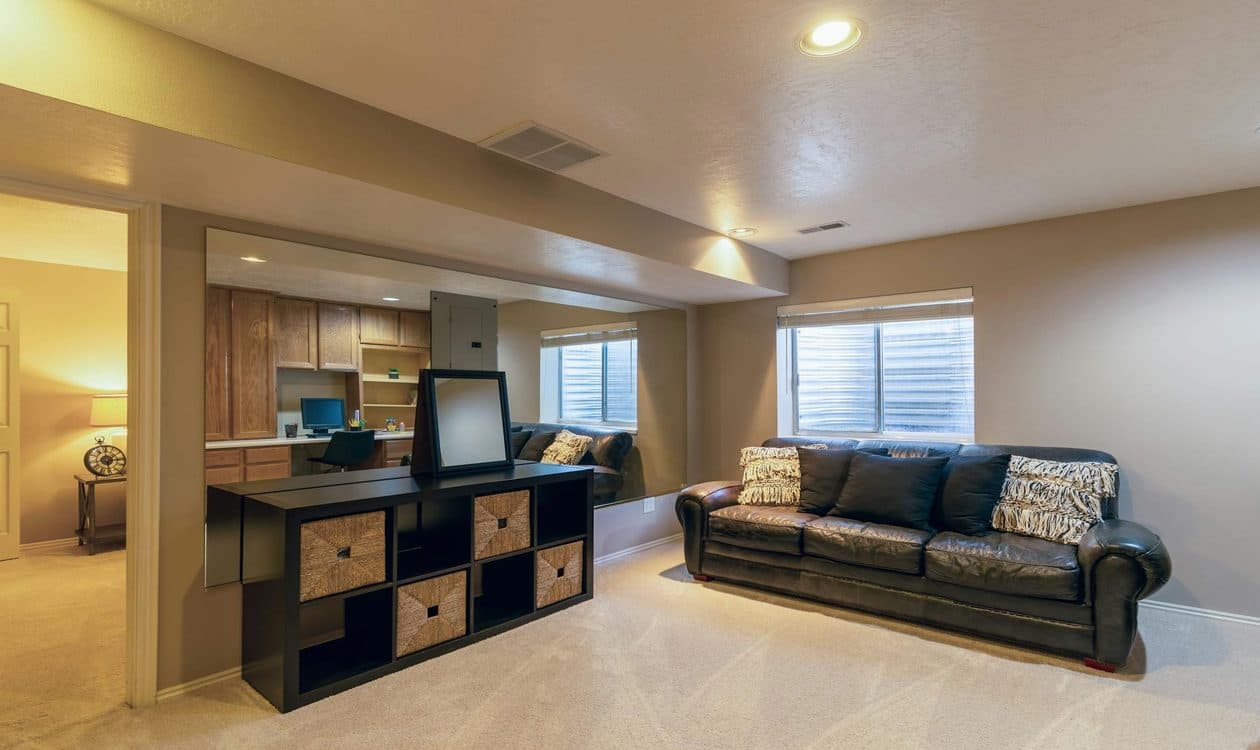
This is why radon shows up in homes here more often than people expect from a warm southern state with no basements in many neighborhoods. The driver is what is under the house, not the climate. Homes built on slabs or with crawl spaces over this bedrock can still draw soil gas indoors, and homes with finished basements, which are common in the hilly terrain around Lake Lanier, have an even more direct pathway for radon to enter and accumulate in living space.
For a deeper look at the rock itself and how it connects to indoor radon, see our companion guide on granite bedrock and radon in north Georgia.
3. Why every home should be tested, no matter the zone
The EPA publishes a Map of Radon Zones that predicts average radon potential by county. It is a useful planning tool, but it was never meant to tell a homeowner whether their specific house is elevated. The map predicts county-wide averages, and radon levels in individual homes vary widely even within the same neighborhood. For that reason, the EPA advises testing every home regardless of the zone it falls in.
A zone designation is not a verdict on your home. A higher-potential county is not a guarantee of high radon, and a lower-potential county is not a guarantee of safety. The only way to know the level in a specific Gainesville home is to test that home.
Across north Georgia, the region's uranium-bearing bedrock means elevated radon turns up in many homes, which makes testing especially worthwhile here. But the underlying advice is universal: test every home, in every zone, because the map cannot see your foundation, your soil, or how your house breathes. To see how levels can swing across the state, our overview of radon levels by ZIP code in Georgia walks through the variation.
4. How radon testing works
Radon testing is simple and non-invasive. A measurement device is placed in the lowest lived-in level of the home, away from drafts, exterior walls, and high humidity, and left in place for the measurement period. There are two broad approaches. A short-term test runs a minimum of two to seven days and gives a quick snapshot, which is why it is the usual choice during a real estate transaction. A long-term test runs more than 90 days and captures seasonal variation, giving a better picture of the year-round average a household actually lives with.
For short-term testing, closed-house conditions matter: windows and exterior doors stay closed except for normal entry and exit so the reading reflects how radon accumulates rather than how much fresh air happened to blow through. Professional testing follows established measurement protocols and uses calibrated equipment, which produces a defensible report. For why testing is the non-negotiable first step no matter what you suspect, see why radon testing is essential.

5. The 4.0 pCi/L action level
Radon is measured in picocuries per liter of air, written as pCi/L. The EPA action level is 4.0 pCi/L. If a home tests at or above that level, the EPA recommends taking action to reduce it. Below 4.0 pCi/L, the risk is lower but not zero, and the EPA suggests considering a fix in the 2.0 to 4.0 pCi/L range as well.
The important thing to understand is that the action level is a decision point, not a line between safe and dangerous. Radon risk rises gradually with concentration and with the years of exposure, so a reading just under 4.0 pCi/L still carries some risk. Many Gainesville homeowners choose to reduce levels below the action level when the cost is reasonable and the family will be in the home for years.
6. What radon mitigation involves
If a home tests high, the fix is well understood. The most common and most effective method is active sub-slab depressurization. A vent pipe is run from beneath the foundation slab, and an inline fan creates a slight vacuum under the slab so that soil gas is drawn into the pipe and routed up and out above the roofline before it can enter the living space. The result is consistent, ongoing reduction rather than a one-time patch.
The exact design depends on the foundation. A slab-on-grade home, a basement, and a crawl space each call for a different approach, and a crawl space often uses a sealed membrane combined with depressurization. After a system is installed, a follow-up test confirms the levels have come down, and a properly designed system keeps working quietly in the background for years with only periodic checks of the fan and the monitor.
7. When Gainesville homeowners should test
The simplest answer is now, if you have never tested. Beyond that, a few moments make testing especially worthwhile. Buying or selling a home is the most common one, since radon is a standard part of due diligence and a clean or mitigated result removes a question mark from the transaction. Finishing a basement, adding a room, or doing foundation work can change how a home draws soil gas, so retesting afterward is wise.
It is also worth retesting every few years even with no changes, because radon levels can shift over time with the soil, the seasons, and the home itself. If you have tested before and the reading was close to the action level, a follow-up test gives you confidence that nothing has crept up. Testing is inexpensive relative to what it protects, which is the long-term health of everyone in the household.
8. Local context for Hall County
Gainesville is the seat of Hall County and the hub of a fast-growing stretch of north Georgia around Lake Lanier, with a mix of older homes, newer subdivisions, and lake properties built into hilly terrain. Georgia does not have a state radon testing law, so testing here is voluntary, and that absence of a mandate is sometimes mistaken for an absence of risk. The geology says otherwise. The same uranium-bearing bedrock that underlies much of the Piedmont and Blue Ridge runs beneath this area.
North Georgia's granite and uranium-bearing bedrock produce elevated indoor radon in many homes across the region. The EPA recommends testing every home regardless of its radon zone, and that advice fits Hall County squarely. A test is the only way to know your home's level.
Practically, that means a Gainesville homeowner should treat radon as a routine part of owning a home here, the same way they treat smoke detectors or a roof inspection. Test once to learn where you stand, mitigate if the level warrants it, and retest periodically. It is a small, manageable step that addresses a real and well-documented health risk specific to this part of the state.
9. Frequently asked questions
This article is general information for homeowners, not medical, legal, or engineering advice. Radon levels vary by home and over time, and EPA guidance can change. The only way to know a specific home's radon level is to test it. Confirm current recommendations with a qualified radon professional before making decisions.