The short answer
Hospitals and medical office buildings test for radon because patients and staff spend long hours inside, and much of the clinical work sits in ground-floor and basement spaces where radon risk is highest. Testing follows ANSI/AARST protocols for commercial buildings, the action level is 4.0 pCi/L, and any area at or above that level should be mitigated and retested until it reads below 4.0 pCi/L. Testing runs in an active facility with minimal disruption, and mitigation is planned around clinical operations. Georgia has no state radon law, but testing is common during acquisitions and financing, and much of metro Atlanta sits in higher-radon areas.
Table of contents
- 1. Why healthcare buildings test for radon
- 2. Which areas carry the most risk
- 3. Long occupancy and a safety culture
- 4. How testing works in an active facility
- 5. Keeping disruption to a minimum
- 6. The 4.0 pCi/L action level
- 7. Mitigation, retesting, and clinical planning
- 8. Acquisition, financing, and liability
- 9. Radon risk in metro Atlanta
- 10. Frequently asked questions
1. Why healthcare buildings test for radon
Radon is a colorless, odorless radioactive gas that seeps up from the soil and collects inside buildings. It is the second leading cause of lung cancer in the United States, and the longer a person breathes elevated levels, the higher the risk. That fact lands differently in a healthcare setting than almost anywhere else, because the people inside are often there for hours at a time, day after day, and some of them already have compromised health.
Staff exposure matters too. Nurses, technicians, lab workers, and administrative teams spend full shifts in the same rooms year after year. Radon exposure is cumulative, so a building that reads high is a quiet, ongoing exposure for the people who keep it running. Testing turns an invisible risk into a number you can act on.
2. Which areas carry the most risk
Radon enters from the ground, so risk is highest where the building touches the soil. In a medical facility that usually means the basement and the ground floor, and those are often exactly the spaces with heavy clinical use. Imaging suites with shielded rooms, laboratories, pharmacy and supply storage, records rooms, and many procedure and exam areas tend to sit on lower levels, sometimes below grade.
Below-grade clinical and imaging spaces are the priority. Because they have more soil contact and often limited natural ventilation, basement-level rooms in a medical building deserve close attention during testing.
Upper floors are not automatically safe. Elevator shafts, stairwells, and utility chases create vertical pathways that let soil gas move upward through a building, so a thorough test plan covers more than just the lowest level. Still, the ground-contact levels are where elevated readings most often show up, and they are where a defensible test plan starts.
3. Long occupancy and a safety culture
Healthcare buildings already run on a strong safety culture. Infection control, air quality, fire safety, and equipment standards are part of daily operations. Radon fits naturally into that mindset because it is one more measurable environmental factor that affects the long-term health of everyone in the building.
The long-occupancy profile is the key difference from a building people pass through quickly. A radon level that might be a modest concern in a low-traffic space becomes a more meaningful exposure when patients recover there over days or weeks and staff work there for years. Testing gives facility leadership a documented basis for decisions about air quality, which is exactly the kind of record a safety-focused organization wants on file.
4. How testing works in an active facility
Testing a commercial building does not rely on a single consumer kit. It follows the consensus standards published by ANSI and the American Association of Radon Scientists and Technologists (AARST) for measuring radon in large and commercial buildings. In practice, that means a planned layout of measurement devices across representative ground-contact rooms and other selected spaces, left in place for a set measurement period, then collected and analyzed.
The devices are small and quiet. They are placed where they will not interfere with patient care or equipment, and they require no power, plumbing, or construction. For a hospital or a multi-floor medical office building, the work is mostly planning: deciding which rooms represent the building, scheduling placement around clinical use, and documenting locations so the report is defensible. You can review the published standards through the AARST standards library.
5. Keeping disruption to a minimum
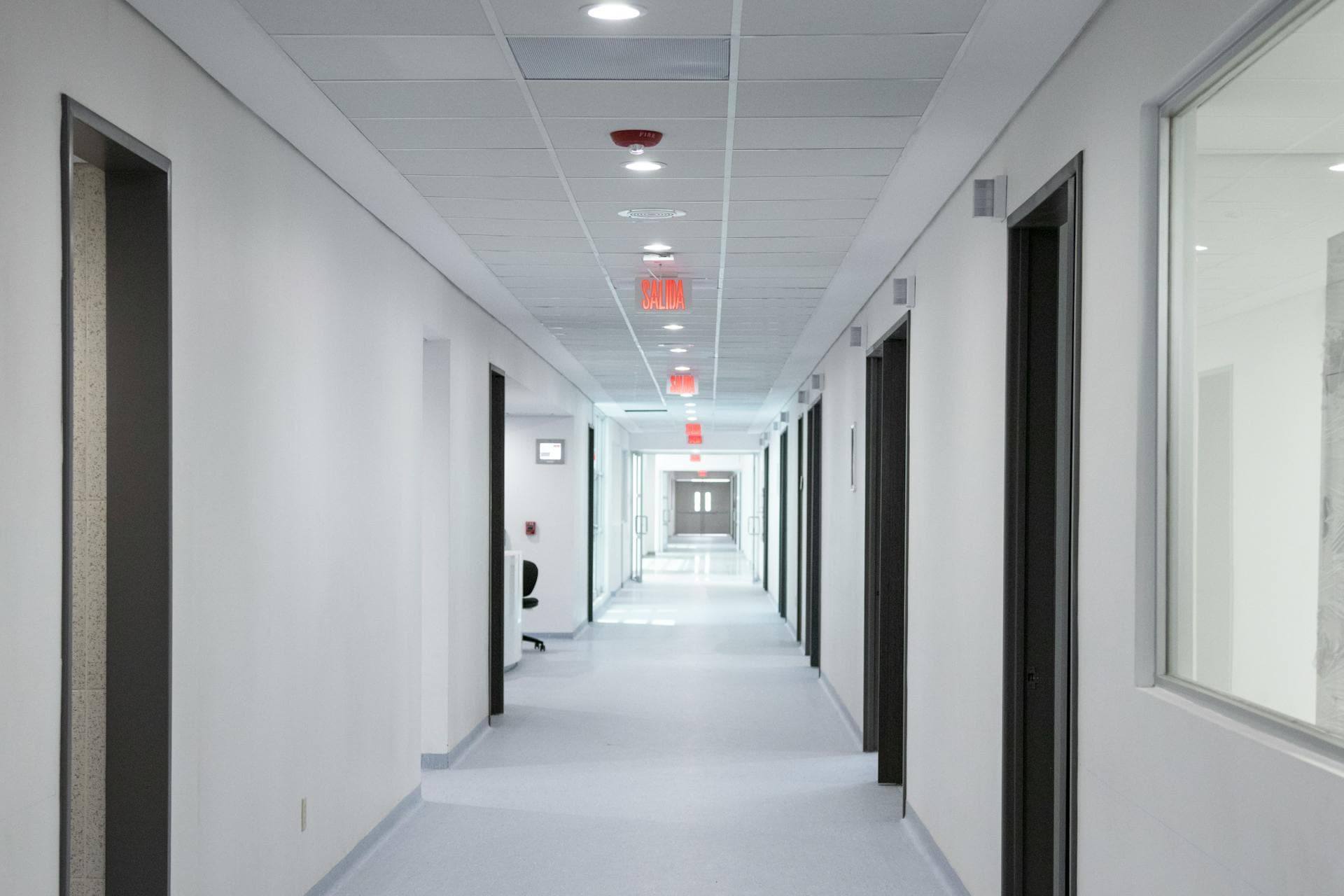
The most common worry from facility managers is whether testing will interrupt operations. It does not. There is no need to close the building, relocate patients, or shut down a department. Device placement and retrieval are quick and quiet, and they are scheduled around the clinical calendar so high-use rooms are accessed at convenient times.
Good coordination is what keeps it smooth. A clear placement plan, a point of contact on the facilities team, and a short notice to staff about the devices are usually all it takes. The measurement happens in the background while the building keeps running as normal, and the result is a documented radon picture without any interruption to patient care.
6. The 4.0 pCi/L action level
The widely used radon action level is 4.0 pCi/L (picocuries per liter). Any area that tests at or above 4.0 pCi/L should be mitigated, and the work is not considered complete until post-mitigation testing confirms the area reads below 4.0 pCi/L. This is the same threshold used across most US radon programs.
It helps to be precise about what the action level means. It is the level at which action is called for, not a clean line between safe and dangerous. Radon risk is continuous, so an area reading just under 4.0 pCi/L still carries some risk. In a long-occupancy healthcare setting, some facilities choose to mitigate when readings approach the action level, especially where patients and staff spend the most time.
7. Mitigation, retesting, and clinical planning
When an area tests high, the path forward is well established. Most commercial radon problems are solved with sub-slab depressurization, a system that draws soil gas from beneath the floor slab and vents it safely above the building before it can enter occupied space. The system is sized for the building, and the fan and piping are routed to limit noise and stay clear of clinical areas.
The same minimal-disruption mindset applies to mitigation. Suction-point locations and riser routing are chosen with the floor plan and clinical schedule in mind, and work in sensitive zones can be staged around operations. After installation, the affected areas are retested to confirm levels below 4.0 pCi/L, and the results are documented. That mitigate-then-retest record is the proof that the problem was actually solved, not just addressed on paper.
8. Acquisition, financing, and liability
Radon testing in healthcare real estate is often driven by a transaction. When a hospital system, a medical office building owner, or an investor buys or refinances a property, environmental due diligence frequently includes radon, and a buyer or lender may want a defensible report before closing. Building the test into the due diligence window keeps an elevated result from becoming a last-minute closing delay.
Liability is the other driver. A documented radon program, with testing to current protocols and mitigation where it is needed, shows that a facility took a known risk seriously and acted on it. For owners and operators, that record matters. For a broader picture of how radon shows up in commercial transactions and lending, see our commercial radon testing guide and our overview of commercial radon services.
9. Radon risk in metro Atlanta
Georgia does not have a state radon testing law, which leads some facility owners to assume radon is not a local concern. The geology says otherwise. On the EPA Map of Radon Zones, four metro Atlanta counties, Fulton, Cobb, DeKalb, and Gwinnett, are Zone 1, the highest category, meaning a predicted average at or above 4.0 pCi/L. Several surrounding north Georgia counties also carry elevated designations driven by the region's granite and uranium-bearing bedrock.
The EPA zone map predicts averages by county. It does not tell you whether a specific building is elevated, and EPA advises testing no matter which zone you are in. A Zone 1 county is not a guarantee of high radon, and a lower zone is not a guarantee of safety. The only way to know a building is to test it.
For a medical facility in metro Atlanta, genuinely elevated regional radon plus a long-occupancy building full of ground-contact clinical space makes high readings common enough to plan for. Testing early, rather than reacting to a problem later, keeps radon from becoming a surprise during a transaction or an unaddressed exposure for patients and staff.
10. Frequently asked questions
This article is general information for facility managers and property owners, not legal, financial, or engineering advice. Radon protocols, standards, and lender policies change over time. Confirm the current requirements that apply to your facility with a qualified radon professional and, where relevant, your lender before making decisions.